
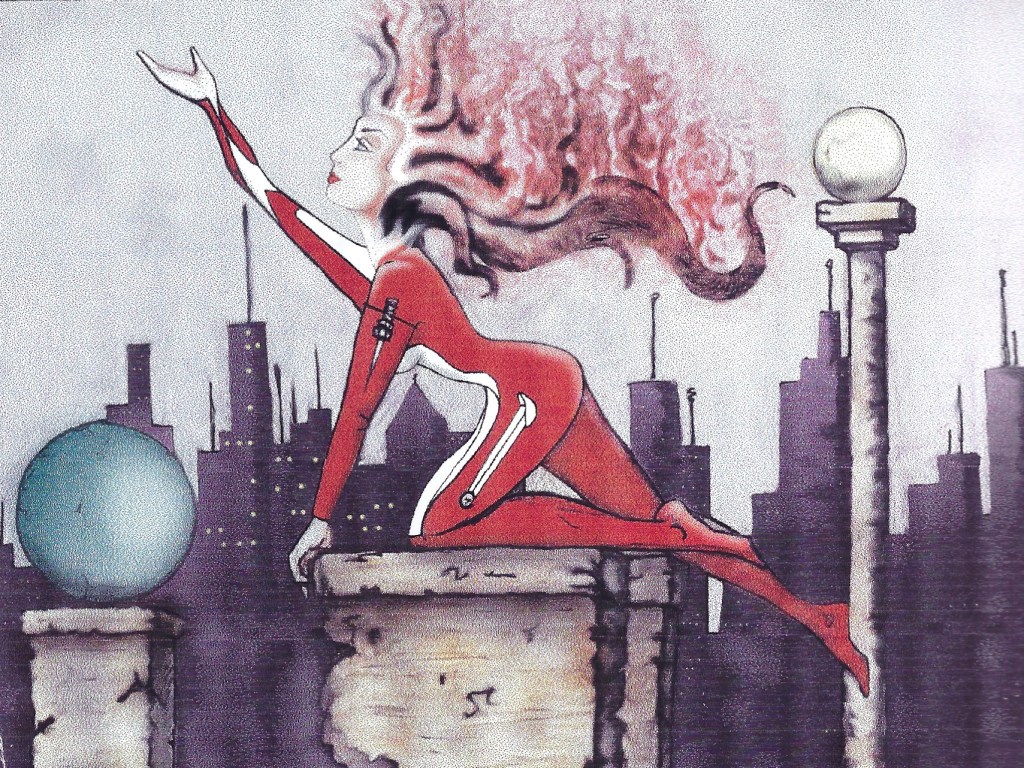
(First a disclaimer: no one was hurt before or after the making of the above sketch…just some fun between old friends bored to death in a classroom – he was quite amused I promise).
I clearly recall sitting in front of my first Apple computer, at the eleventh hour on a weeknight in 1996 – on the brink of tears as the dial-up modem screamed out its agonizing efforts. It was sheer torture – the minutes that passed by. I had earned a spot in the San Jose State University Graphic Design program and was feverishly trying to keep up with my talented cohorts. I do not exaggerate. These students held vision, conceptual artistic prowess, and intimidatingly awe-inspiring confidence – it weakened me at the knees. How was I ever to compete – pure perseverance and the sheer will to work harder than anyone else.
After earning my Associate’s Degree, I submitted my portfolio to the Graphic Design program at San Jose State University. I was admitted (on probation) on the contingency that although my work was good enough for now and until the next portfolio review to be held a few months down the line I would have to resubmit my work to show that I had made significant progress. It was all I needed – a chance to prove myself.
The program consisted of classes based on the fundamental principles of graphic design that included color, composition, hierarchy, typography, and branding. If I recall correctly, we spent 20 percent of the semester in lectures, 60 percent on conceptualization and brainstorming, and 20 percent on execution – none of which entailed any use of software whatsoever. “You’re here to learn about graphic design, this is not a software school,” spewed an insulted professor as one of my classmates asked timidly about using amazing new software called Illustrator. He was a stodgy, stiff-lipped, and cantankerous man that did more to stifle creativity than inspire it. He was correct though. Way back then, to use graphic design software was to contaminate the unadulterated finery of old-school crafted graphic design created by purists’ hands. This was to be to my advantage because conceptualization is my thing. And boy could I go way outside of the box. Needless to say, we were on our own to learn the promising new graphic design digital tools.

We rebelled. We were going to use this fascinating technology whether those grumps liked it or not. Learning Illustrator and Photoshop in the early years of their existence, absent the ubiquitous how-to-videos, online and in-person courses, and the plethora of books available today was a struggle and honestly painful, to say the least but as the years progressed, we became more proficient, and our end products became awe-inspiring and exciting. We continued to use old-school methods by implementing photography, hand-painted textures, and illustrations and utilized this new technology to amalgamate the two techniques into art more efficiently produced. It was fun to explore. With the discovery of Photoshop came the use, experimentation, and some say overuse/abuse of Photoshop filters (as you can see I had happily abused the use of Photoshop filters in the creation of Red Girl before I knew better – but in any case, hold no regrets). It is through fiddling and failing that you build new skills.

Nonetheless, I have created magnificent graphics that only software can produce more accurately, pristinely, and efficiently. Above is an exceptional example of the building of a concept in Aaron James Draplin‘s design book, Pretty Much Everything. It clearly maps out the process in which he researches, discovers, studies, conceptualizes, sketches, and ultimately with the assistance of graphic design software creates the Grizzly Habitat logo. The book is a must-have if you love graphics. The reader is a proverbial fly on the wall of Aaron’s artistic journey as he lays it out on the pages of his book for those who hunger for a visual and textural feast. Aaron is a creative genius in my opinion and his book not only reveals an endless array of great graphic design and its endless applications but is also entertaining to read!
Long story made not so much shorter, I made it through the program. I wasn’t the most talented and still do not consider myself to be but I gave and give my all as I do with most of everything I do and eventually the digital tools became my friend.

As wonderful as these graphic design tools are, there is nothing that can replace the grittiness of a pencil’s graphite strike and its scattered remnants, the finery in a Conte crayon and vine charcoal smear, the depth of meaning in each paintbrush stroke, the absence of it in the removed spaces made by a kneaded eraser, all authentic marks, and remarks put on paper and canvas, made by hand. The process promotes deeper thought, connections, emotions, and experiences for artists and conceptual designers and that is part of why we do it.
Adobe Creative Suite gave me the ability to play within this digital realm of discovery and creation and with the new innovation of new technology comes forth the endless ways to which we can share external expressions of our internal creative fantasies with audiences abound.
Follow me here or on Twitter @NancyMuesDesign or let’s connect on Linkedin or Facebook! Share your thoughts or your own experiences here in the comment section.
And remember, express yourself in any way that brings you joy and relief and share it with the world. You don’t owe it to anyone but yourself. Happy graphics, my friend. And as Paul Mellender says, “Artist…and that should be enough, wouldn’t you agree?” I think I do.
Graphic Design (verb): the ultimate trust enhancers, content simplifiers and organizers, efficient and effective information communicators, emotion evokers, and cognition captivators.

 Nancy Mues